

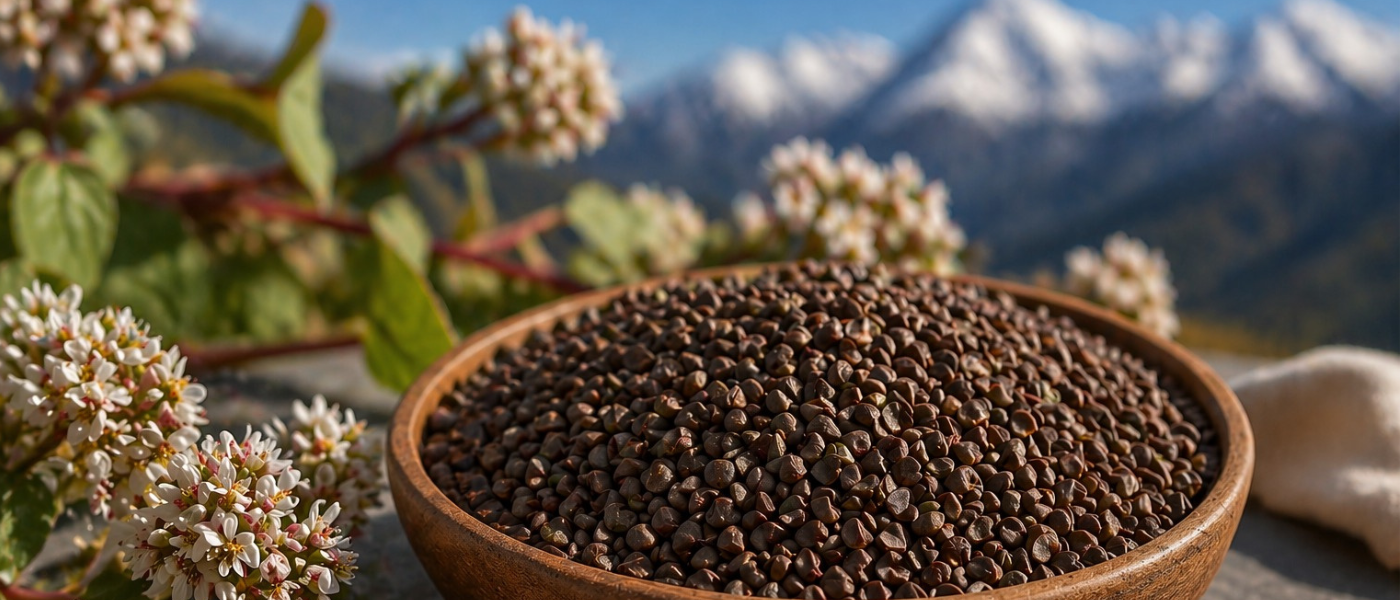

High in the Himalayan mountains, where UV radiation is intense and growing conditions are harsh, a remarkable seed has been quietly thriving for thousands of years. Himalayan Tartary Buckwheat (HTB) — known scientifically as Fagopyrum tataricum — is not a grain in the botanical sense. It is a seed from a broadleaf plant in the Polygonaceae family, making it a pseudo-cereal: a seed that is used like a grain but is not related to wheat, rice, or any true cereal grass. And yet it is increasingly recognized by researchers as one of the most polyphenol-rich food crops on the planet, with a growing body of science suggesting it may play a meaningful role in how the body manages energy, regulates cellular metabolism, and maintains healthy body composition.
A Seed Unlike Any Other
Because buckwheat is a pseudo-cereal — a seed rather than a true grain — its nutritional architecture differs significantly from the cereal crops most of us eat daily. Research published in Plants (2023) confirms that Tartary buckwheat is characterized by a nutritionally excellent profile with higher levels of protein alongside balanced amino acids, dietary fiber, vitamins, and minerals. Compared to wheat, brown rice, oats, and millet, HTB contains substantially higher levels of iron, zinc, selenium, and key B vitamins. It contains all essential amino acids in well-balanced proportions — a rarity in the plant kingdom — and researchers have noted that its amino acid composition has "important research prospects in health functions, such as anti-aging and improving metabolism."
The Rutin-Quercetin Connection and Metabolic Balance
Rutin and its metabolic derivative quercetin are arguably the most studied of HTB's bioactive compounds — and for good reason. In a randomized, double-blind, placebo-controlled clinical trial published in the Journal of Functional Foods (2016), participants consuming rutin-rich Tartary buckwheat products over 12 weeks showed statistically significant reductions in body weight and BMI, with additional benefits to loss of body fat in the Tartary buckwheat versus placebo group.
How does this work? Researchers point to a key cellular energy sensor known as AMPK — AMP-activated protein kinase. This enzyme acts like a master metabolic switch, regulating how cells generate and use energy. Studies referenced in the Journal of Functional Foods trial found that rutin activates AMPK in skeletal muscle and promotes mitochondrial biogenesis — essentially signaling cells to produce more mitochondria, the organelles responsible for generating ATP, the body's primary energy currency. More mitochondria can mean more efficient energy conversion from the foods we eat.
Quercetin, which the body produces from rutin through normal digestive processes, adds another dimension. It can cross the blood-brain barrier, accumulate in brain tissue, and has been linked in the research literature to modulation of fat storage pathways. A review in Frontiers in Nutrition (2023) confirms that Tartary buckwheat flavonoids have distinct blood sugar regulating influences and may help protect against aspects of oxidative stress — key upstream factors in how the body partitions energy between storage and use.
Oxidative Balance and Metabolic Efficiency
Energy metabolism is not a clean process. When cells convert food into energy, they generate reactive oxygen species (ROS) — unstable molecules that, when left unchecked, can impair cellular machinery and impair metabolic function. Maintaining a healthy balance between ROS production and antioxidant defense is central to how efficiently the body generates and uses energy over time.
This is where HTB's polyphenol richness becomes particularly relevant. As documented in Frontiers in Nutrition, quercetin's DPPH-scavenging activity has been measured at approximately 148% of vitamin C, and its superoxide anion scavenging ability at around 183% of vitamin C — making it one of the most biologically active antioxidant compounds found in whole foods.
In the clinical body composition study, participants consuming rutin-rich Tartary buckwheat showed significantly lower levels of TBARS — a well-established marker of oxidative stress — compared to the placebo group. Notably, BMI increases in the placebo group correlated with rising TBARS levels, while no such correlation emerged in the active group. This suggests that HTB's antioxidant compounds may help buffer the cellular burden that accompanies shifts in body composition, supporting cleaner, more efficient metabolic function.
HTB's protein fraction contributes here as well. Research reviewed in Frontiers in Nutrition (2023) shows that Tartary buckwheat protein increases the activity of superoxide dismutase (SOD) and glutathione peroxidase (GSH-Px) — two of the body's primary endogenous antioxidant enzymes — while reducing markers of oxidative cellular stress. These enzyme systems are foundational to sustained energy production.
Blood Sugar and Metabolic Rhythm
Metabolic health is not defined by any single variable, but by the rhythm of many systems working in concert — blood sugar regulation, lipid balance, liver function, and cellular signaling. HTB appears to influence several of these pathways simultaneously.
D-chiro-inositol, a naturally occurring compound found at elevated levels in HTB, plays a recognized role in insulin signal transduction and glucose metabolism — and germination can increase its concentration up to ninefold, according to findings summarized in the Frontiers in Nutrition sprouting review. The resistant starch naturally present in buckwheat seeds also contributes to a lower glycemic index compared to refined grain products, which could help with regulating blood sugar and promoting a sustained energy experience after eating.
Sprouting: Nature's Amplifier
One of the most exciting recent developments in HTB research concerns the sprouting process. When Tartary buckwheat seeds germinate, a cascade of enzymatic activity transforms the seed's nutritional profile dramatically. As documented in the Frontiers in Nutrition sprouting review (2023), germination increases total phenolic content by more than 42% and antioxidant capacity by over 32% compared to hulled seeds, while a 2022 study in Food Hydrocolloids noted an increase in antioxidant capacity of 64% after sprouting. In university-tested comparisons specific to Himalayan Tartary Buckwheat phenolic content has been found to increase by up to 2-fold or higher when sprouted.
The Molecules phytochemistry review adds further detail: while Tartary buckwheat seeds contain approximately 914 mg of rutin per kg dry weight, the resulting sprouts contain approximately 10,000 mg per kg — more than a tenfold increase. Catechin concentrations rise from approximately 4,510 mg per kg in seeds to 7,000–8,000 mg per kg in sprouts.
Sprouting also increases concentrations of GABA (gamma-aminobutyric acid), free amino acids, and key flavonoids while improving the overall digestibility of both protein and starch. The result is a food form that is not only more nutritionally dense but more bioavailable — meaning the compounds that support metabolic function are more readily absorbed and utilized by the body.
Big Bold Health, the company that has pioneered the use of sprouted HTB as a whole-food ingredient, recently launched the largest randomized, placebo-controlled clinical trial ever conducted on a single food ingredient focused on brain health and immune function, with 850 participants enrolled. While outcomes are still pending, the scale of this research reflects the depth of scientific interest now being directed at what this ancient seed can offer.
An Ancient Seed for a Modern Challenge
The body's capacity to generate and sustain energy — to convert food efficiently into vitality, manage weight with less effort, and maintain the metabolic balance that underlies how we feel day to day — is not simply a function of calories in and calories out. It is a complex biological story that involves mitochondrial function, antioxidant defense, blood sugar rhythm, cellular signaling, and the gut microbiome.
Himalayan Tartary Buckwheat, particularly in its sprouted form, appears to interact with many of these systems simultaneously. It is not a drug. It is a seed — one that has been prized for its nutritional characteristics for thousands of years and is now being studied with the rigor of modern clinical science. For those looking to support their metabolic vitality through what they eat, it may be one of the most compelling whole-food options that science has yet uncovered.


